Meghalaya's Wangala Festival Sets Guinness World Record
Meghalaya's Wangala Festival enters the Guinness World Records with a massive performance of 1,000 drums and 3,000 dancers.
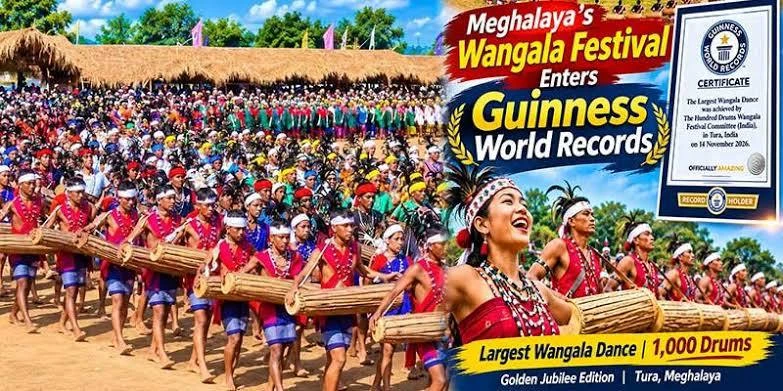
The rhythmic pulse of the Garo Hills has officially made history. In a spectacular display of tradition and unity, Meghalaya’s annual Wangala Festival has entered the Guinness World Records for the "Largest Wangala Dance," marking a monumental milestone during its golden jubilee celebrations.
The historic achievement was officially confirmed on November 14, 2026, at the Garo Heritage Village, Wangala A'dam, in Chibragre, near Tura. During the four-day event, the air was filled with the thunderous sound of over 1,000 traditional Dama drummers and the synchronized movements of approximately 3,000 dancers. This massive "Rhythm of 1,000 Drums" was performed to honor the sun god, Misi Saljong, creating a spectacle that captivated both the local community and international observers.
The record was validated by Guinness World Records adjudicator Richard Williams Stenning from the United Kingdom, who was supported by a 12-member team from the Garo Hills. The scale of the celebration was matched by significant state investment, with the Meghalaya government allocating ₹20 crore for the development of the Wangala A'dam venue and an additional ₹6 crore to host the jubilee festivities.
A Vision Realized for the Garo Community
Chief Minister Conrad K. Sangma hailed the achievement as the realization of a long-held vision by his late father, former Lok Sabha Speaker P.A. Sangma. The event also saw the presence of Union Minister of Culture and Tourism Gajendra Singh Shekhawat, who emphasized the festival's immense potential to boost cultural tourism and support local livelihoods in the West Garo Hills. He further urged for the formal documentation of the region's rich folklore and rituals.
The milestone was also celebrated by other key leaders, including Deputy Chief Minister Sniawbhalang Dhar and Leader of Opposition Dr. Mukul M. Sangma, both of whom praised the community's unwavering dedication to preserving the unique Garo cultural heritage. To ensure the success of the record attempt, approximately ₹36.65 lakh was specifically dedicated to the Guinness World Records application and the necessary logistics.