Koch-Rajbongshi Groups Protest in Bongaigaon for ST Status
Koch-Rajbongshi organizations stage sit-in protests in Bongaigaon demanding Scheduled Tribe status and the formation of a separate Kamatapur state.
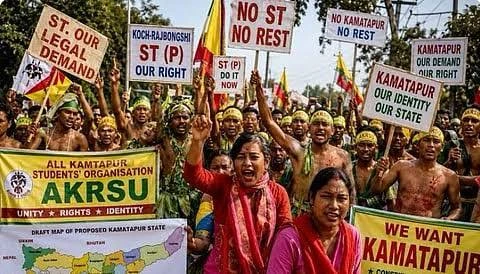
Hundreds of activists from Koch-Rajbongshi organizations, including the All Koch-Rajbongshi Students' Union (AKRSU), the Koch-Rajbongshi Mahila Samiti, and the Chilarai Sena, staged a massive sit-in protest in Bongaigaon, Assam. The demonstrators gathered outside the District Commissioner's office on November 17, 2026, to demand Scheduled Tribe (ST) status for their community and the creation of a separate Kamatapur state.
The protest, which lasted three hours, follows similar demonstrations held on November 16. Manoj Ray, president of AKRSU, warned that the movement would escalate into larger democratic agitations if the Central government continues to delay crucial tripartite talks regarding these long-standing demands.
A History of Political Struggle
This movement is part of a broader regional push. Recently, the Kamatapur State Demand Council (KSDC) held a mass gathering in Kokrajhar, advocating for the inclusion of the Koch-Rajbongshi language in the Eighth Schedule of the Constitution and the release of KLO chairman Jibon Singha Koch. While the KSDC (Democratic) has temporarily paused protests in Kokrajhar following an invitation for talks from Assam Chief Minister Himanta Biswa Sarma, activists remain cautious.
Boloram Barman, general secretary of AKRSU, emphasized that any upcoming discussions must result in concrete progress rather than mere delays. The community's struggle for ST status is historically complex; after a brief period of recognition in 1996, the status was later revoked following opposition from other tribal groups, including the Bodos, Rabhas, Dimasas, and Garos, who expressed concerns over the potential dilution of their own reservation benefits. Additionally, the Registrar General of India had previously rejected the demand between 1981 and 2006, citing the community's socio-economic standing.